
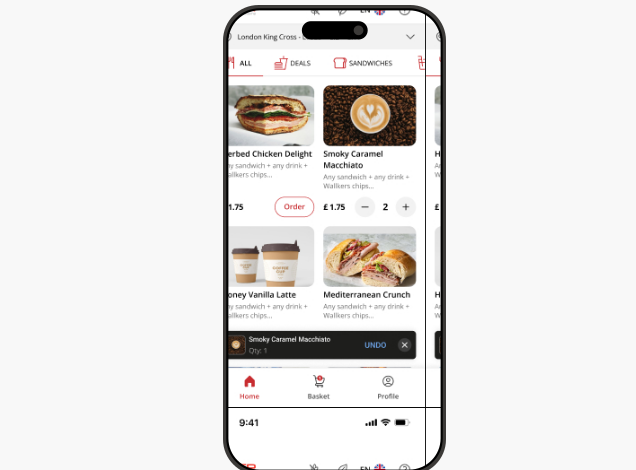
There is no shortage of EPOS and stock platforms that look polished in a demo.
Clear screens. Smart dashboards. Attractive mobile devices. Smooth workflows.
But onboard rail retail is not shop retail, and it is not hospitality in the usual sense either. It is a highly specific operational environment with moving stock, changing crews, patchy connectivity, short service windows, limited space, and a constant need to keep sales moving while maintaining control.
That is where many organisations can come unstuck.
A system may look impressive on the surface, but if it has not been designed around the practical realities of onboard rail, the problems tend to show up very quickly. Not in the demo, but in live operation. In missing stock. In poor visibility. In manual workarounds. In inconsistent reporting. In lost sales opportunities. In revenue leakage that is hard to trace and even harder to correct.
For anyone reviewing their current setup, or considering a change, the starting point should not be: which EPOS system looks best?
It should be: which system actually understands rail?
The common trap
A great many systems can process a sale.
That, on its own, is not a high bar.
The real question is whether the system can support the wider onboard retail operation around that sale. Because in rail, the sale is only the visible moment. The real challenge sits behind it:
- what stock was loaded where
- which crew member had responsibility for it
- what happened when a journey changed
- what was sold, returned, written off or left on board
- whether replenishment decisions were sensible
- whether the operator can actually see what is happening, in time to act on it
This is where generic systems often struggle.
Many have been adapted for rail, rather than built around it. They may handle transactions perfectly well, but still leave operators dependent on manual intervention, spreadsheets, delayed reconciliations, or disconnected back-office processes. The result is often a system that appears modern, but does not give the business the control it expected.
Rail is operationally different
Onboard retail in rail has a number of characteristics that make it fundamentally different from most other retail environments.
A train is moving. Connectivity is not always reliable. Crews change. Services change. Trolleys and stock locations move. The selling window may be narrow. Service patterns vary by route, class of service, daypart and geography. In some cases, even the rules around what can be sold may change depending on where the train is.
That means a rail-specific platform should not simply record transactions. It should help the operator manage complexity without adding to it.
At a minimum, it should be able to support:
- operation when connectivity drops
- accurate stock visibility across trains, trolleys, depots and other stock locations
- clear handling of loaded stock, sold stock, remain-on-board stock and returned stock
- practical reconciliation at journey level
- workflows that reflect how crews actually work, not how a shop works
- timely and meaningful reporting that supports operational decisions
Without that, it becomes very difficult to answer even basic questions with confidence:
- Where has the stock gone?
- Why are certain services underperforming?
- Are we loading the right products?
- Are losses due to demand, process failure, or control issues?
- Which issues need training, and which need system change?
What looks good from the outside is not always strong underneath
This is often the critical distinction.
A platform can offer attractive front-end screens and still be weak in the areas that matter most operationally. In fact, this is one of the most common risks in procurement and review exercises: the visible part of the system can dominate attention, while the underlying rail logic receives less scrutiny than it should.
A few warning signs are worth watching for.
1. The system treats rail like static retail
If the logic assumes fixed stock locations, stable staffing, and uninterrupted connectivity, there is likely to be trouble ahead.
2. Stock control relies too heavily on manual discipline
Good people matter, of course, but a rail retail system should reduce dependence on fragile manual processes, not build its success around them.
3. Reporting arrives too late, or without enough context
A report is only useful if it helps someone act. If visibility is delayed, partial or difficult to interpret, problems often become embedded before they are spotted.
4. Operational exceptions are handled outside the system
When journey changes, shortages, returns, or handovers are managed by phone calls, workarounds or offline notes, control weakens very quickly.
5. The provider understands software, but not onboard rail operations
This may be the most important of all. A technically competent supplier can still miss what actually matters if they do not understand the environment they are serving.
What should rail operators be asking instead?
A better review process starts with operational questions, not feature lists.
For example:
How does the system handle stock as it moves through the day? Not just at the point of loading and sale, but through journey changes, crew changes, returns and replenishment.
What happens when the device loses connection? Can the crew continue selling properly? What syncs later? What risks arise in the meantime?
How does the system support reconciliation and revenue assurance? Can discrepancies be identified at the right level, and quickly enough to be useful?
Can the operator see performance by route, journey, product, team or service pattern? And can that visibility drive better decisions on loading, ranging and replenishment?
How much manual correction is required behind the scenes? A system may appear efficient on the front line while creating large amounts of hidden back-office effort.
Does the workflow reflect the reality of onboard service? Or does it feel like a retail package that has been adapted for trains?
These questions tend to reveal far more than a long list of functional bullet points.
The cost of getting it wrong
When a rail operator ends up with a system that is not genuinely rail-specific, the consequences are rarely dramatic on day one. More often, they build gradually.
A little uncertainty over stock becomes routine. Reporting requires interpretation. Reconciliation takes longer than it should. Crews lose confidence in parts of the workflow. Managers cannot quite see where losses are occurring. Opportunities to improve product mix or service performance are missed. Workarounds become normal.
Over time, that can mean:
- avoidable shrinkage
- revenue leakage
- poor stock accuracy
- wasted loading and replenishment
- weaker forecasting
- reduced confidence in reporting
- lower operational agility
- a frustrating gap between what the system promised and what it delivers in practice
That gap matters. Because onboard retail is already operationally demanding enough without the system making it harder.
So where should someone start?
Start with the operation, not the software.
Map the full journey of stock and sales through a typical day. Then stress-test it with real-life exceptions.
- What happens when a service changes?
- What happens when a crew swaps over?
- What happens when connectivity drops?
- What happens when stock remains on board?
- What happens when shortages or discrepancies appear?
- What happens when management needs to understand performance quickly?
If a supplier cannot explain clearly how their platform supports those realities, that is a warning sign.
The best rail retail systems are not simply EPOS tools with a rail badge on them. They are operational control platforms built around the specific demands of rail.
That does not always make for the flashiest pitch. But it is what makes the difference in live service.
A useful conversation for the sector
That is very much the thinking behind our annual Rail Catering Day forum. It is held as a practical discussion around onboard retail, stock, operational challenges, and the direction platforms need to move in if they are truly to support rail properly.
For those involved in onboard catering and retail, there is real value in stepping back from the sales language and asking the harder question: what does a rail retail system need to be good at, beneath the surface, if it is genuinely going to help the business?
If these questions resonate, they are exactly the kind of topics we will be exploring at our upcoming Rail Catering Day forum on June 23rd 2026. The aim is to create a worthwhile discussion between those working in rail onboard retail and catering about the realities, pressures and opportunities shaping the sector. For anyone close to these challenges, it should be a valuable opportunity to exchange ideas with industry peers. If you would like to attend, contact us today to reserve your place.