
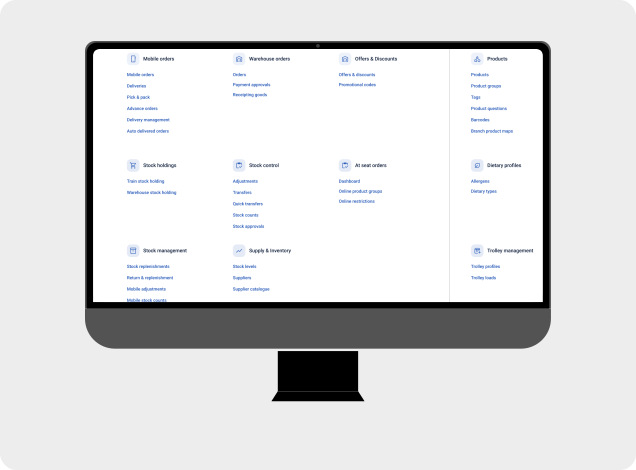
Rail EPoS is electronic point of sale software designed for onboard retail and catering on trains. It allows crew to sell products, take payments, manage stock, handle offline trading, support at-seat ordering and reconcile sales and stock after each journey.
Unlike standard point of sale, rail EPoS needs to support a moving retail environment. Trains are not fixed shops. They operate across routes and journeys, with changing crews, limited space, variable connectivity and stock that moves between fulfilment centres, trains, trolleys, bars and onboard storage.
For train operators and rail catering providers, a rail EPoS system is therefore not just a till. It is the operational platform that supports onboard sales, stock control, customer ordering, crew workflows, payment handling, reporting and reconciliation.
What does EPoS mean in rail?
EPoS stands for electronic point of sale. In simple terms, it is the system used to process sales and record transactions.
In a rail environment, however, EPoS needs to do more than process payments. It needs to support the way onboard retail actually works.
This may include:
- crew sales on handheld devices;
- trolley and bar service;
- product availability by route or journey;
- onboard stock control;
- fulfilment centre loading;
- at-seat ordering;
- offline trading;
- payment integration;
- wastage and stock adjustments;
- journey-based reporting;
- end-of-shift reconciliation.
A rail EPoS system therefore needs to connect the sales transaction with the stock, crew, train and journey behind it.
How is rail EPoS different from normal retail EPoS?
Normal retail EPoS is usually designed around fixed locations. A shop has a till, a stockroom, staff assigned to that site and a stable connection. Sales are processed in one place and stock is usually held in known locations.
Rail is different.
The sales environment moves. The crew move. The stock moves. Connectivity can be unreliable. Service patterns can change. Space is limited. Customers may order from their seats. Stock may be loaded from a fulfilment centre and sold from a trolley, bar or onboard storage point.
This means rail EPoS needs to handle more complex operational relationships than standard EPoS.
It needs to understand:
- which device is being used;
- which crew member is signed in;
- which journey is being operated;
- which train or service the stock belongs to;
- which trolley, bar or onboard location is being used;
- what products should be available;
- how sales and stock should be reconciled.
Without that context, operators may still record transactions, but they may struggle to manage the onboard retail operation efficiently.
Why offline operation matters
Connectivity on trains is not always reliable. A system that depends on a constant connection can create problems for crew and customers.
Rail EPoS should therefore support offline or low-connectivity operation. Crew need to continue serving customers even when the network drops. Sales, stock movements and other activity should be stored safely and synchronised when the connection becomes available again.
This is especially important for onboard retail because the customer interaction is immediate. If a passenger wants to buy food or drink during the journey, the crew member needs to be able to serve them without waiting for a stable signal.
Offline capability is not just a technical feature. It is an operational requirement.
How rail EPoS supports stock management
Stock management is central to onboard retail.
A rail operator or catering provider needs to know what has been loaded, what has been sold, what has been wasted, what has been returned and what needs to be replenished.
Rail EPoS can support this by connecting sales with stock locations and stock movements.
For example, stock may need to be tracked across:
- fulfilment centres;
- depots;
- trains;
- trolleys;
- bars;
- onboard storage;
- crew devices;
- returns and wastage points.
When sales and stock are managed in the same platform, operators have a clearer view of availability, variance and performance. This can reduce manual work, improve replenishment and support better reporting.
How rail EPoS supports at-seat ordering
At-seat ordering allows passengers to order food, drink or other items from their seat. However, it only works properly if it is connected to the onboard operation.
A customer-facing order page is only one part of the process. The system also needs to know whether the service supports at-seat ordering, what stock is available, how the crew will receive the order, how payment is handled and how the sale affects stock.
Rail EPoS can connect these elements so that at-seat ordering becomes part of the same workflow as crew sales and stock management.
This is important because disconnected systems can create operational problems. Orders may not reflect actual onboard availability. Crew may need to manage separate devices or processes. Sales and stock may need to be reconciled manually later.
A connected rail EPoS platform helps avoid those gaps.
What should train operators look for in rail EPoS?
When selecting a rail EPoS system, train operators and catering providers should look beyond the basic ability to process a sale.
Important questions include:
- Was the system designed for rail, or adapted from standard retail?
- Can it support poor or intermittent connectivity?
- Can it manage stock by train, trolley, bar, journey and fulfilment location?
- Can it support at-seat ordering as part of the onboard workflow?
- Can crew use it quickly and reliably during service?
- Can it handle wastage, adjustments, returns and variance?
- Can it report by journey, route, crew, train, product and location?
- Can it integrate with payment providers, finance systems and wider business reporting?
- Can it support both current onboard operations and future service models?
The right rail EPoS system should support the full onboard retail operation, not just the transaction.
Where RailPro fits
RailPro by ECR is a rail EPoS and onboard stock management platform built for train operators and rail catering providers.
It supports onboard point of sale, at-seat ordering, stock control, fulfilment workflows, offline operation, payments, reporting and reconciliation. It is designed around the practical realities of onboard retail, including moving stock, changing journeys, crew workflows and variable connectivity.
For operators, RailPro provides a single platform for managing sales and stock across the onboard retail environment.